Back to the menu

What Happens If You File Your Taxes Late? IRS Penalties Explained

If you miss the tax filing deadline, the consequences depend on whether you owe taxes or are due a refund. Filing your taxes late can lead to IRS penalties, interest charges, and added stress—but the outcome isn’t the same for everyone.

Understanding how the IRS handles late tax returns helps you take the right next steps and reduce the financial impact.

Table of Contents

What Is the IRS Tax Filing Deadline?

The federal tax filing deadline is typically April 15th, unless it falls on a weekend or holiday. For the 2025 tax year, the deadline remains April 15th.

It’s important to know that the IRS treats filing your return and paying your taxes as separate requirements. Missing either deadline can result in penalties and interest.

What Happens If You File Taxes Late?

If You Are Due a Tax Refund

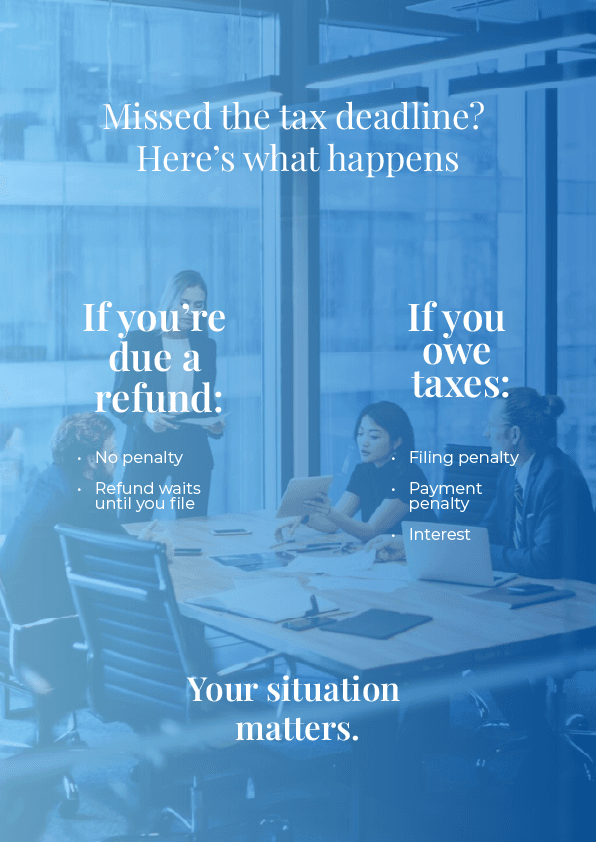
If the IRS owes you a refund, there is no penalty for filing late. However:

  • The IRS does not issue refunds until a return is filed
  • You have three years from the original deadline to claim your refund
  • After three years, the refund is permanently forfeited

If You Owe Taxes

If you owe taxes and file late, the IRS applies penalties and interest until action is taken. Filing your return as soon as possible limits the damage.
IRS Penalties for Filing Taxes Late

Failure-to-File Penalty

The failure-to-file penalty is the most severe IRS penalty for late tax returns.

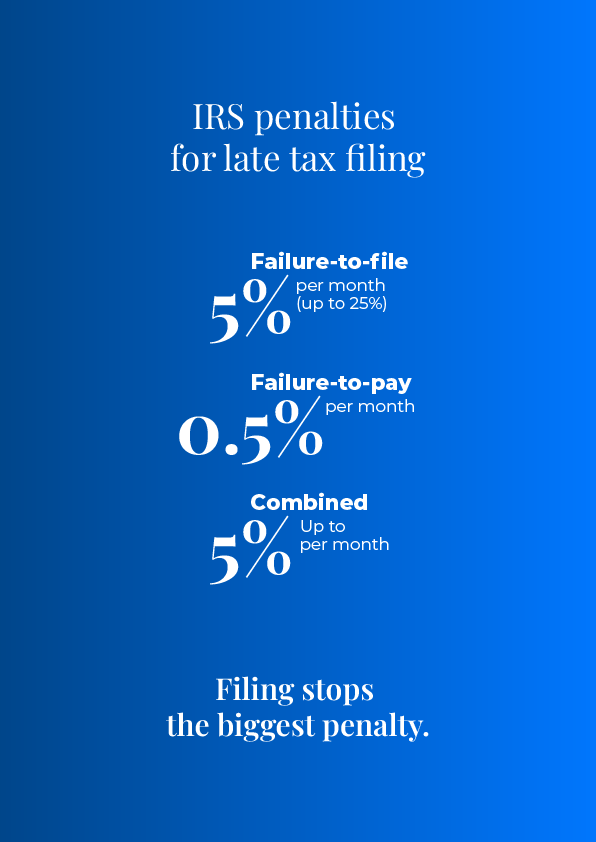
  • 5% of unpaid taxes per month
  • Capped at 25% of the total tax owed
  • Begins accruing the day after the filing deadline
  • Stops once the return is filed

Interest compounds daily on both the unpaid tax and the penalty.

Failure-to-Pay Penalty

The failure-to-pay penalty applies when you file but don’t pay the full balance.

  • 0.5% per month on unpaid taxes
  • Capped at 25%
  • Can increase to 1% per month after IRS levy notices
  • Reduced to 0.25% per month with an approved payment plan

Combined IRS Penalties

When both penalties apply in the same month:

  • Failure-to-file penalty drops to 4.5%
  • Failure-to-pay penalty remains 0.5%
  • Combined penalty equals 5% per month

IRS Interest Charges

In addition to penalties, the IRS charges interest on unpaid balances.

  • Interest compounds daily
  • Rate equals the federal short-term rate plus 3%
  • For early 2025, the rate is approximately 7%
  • Interest is rarely waived

What to Do If You Miss the Tax Filing Deadline

Taking action quickly reduces penalties and interest.

  1. File your tax return immediately
    Stops the failure-to-file penalty from increasing.
  2. Pay as much as you can
    Lowers interest and reduces failure-to-pay penalties.
  3. Set up an IRS payment plan
    Keeps penalties at reduced rates and prevents aggressive collection.
  4. Request penalty relief if eligible
    First-time abatement or reasonable-cause relief may apply.
  5. File for an extension in future years
    Form 4868 extends filing—not payment—deadlines.

Special Situations That May Reduce Penalties

Natural Disasters

  • Automatic filing and payment extensions
  • Penalty relief for federally declared disaster areas

Military Service

  • Extended deadlines for active-duty service in combat zones
  • Includes filing, payment, and other tax actions

Living Abroad

  • Automatic two-month filing extension
  • Interest still applies to unpaid balances

Get Help Filing Taxes Late with SSL Associates

Filing taxes late can feel overwhelming, but it doesn’t have to spiral out of control. With the right plan, penalties can be limited and stress reduced.

SSL Associates helps clients:

    • File late tax returns correctly

    • Reduce penalties where possible

    • Set up IRS payment plans

    • Communicate effectively with the IRS

If you’ve missed a tax deadline or are unsure what to do next, our team is ready to help you regain control.

Susan S. Lewis

Susan Lewis is a seasoned CPA and financial advisor with over 40 years of experience. She founded SSL Associates, offering personalized financial guidance and tailored solutions to help businesses achieve financial excellence.

Take the First Step Towards Financial Success - Contact Us Today!

Let’s transform your finances together. Schedule a consultation to unlock your path to success with our certified public accountants.

Similar Posts

Learn about Yellow Book Audits, when they’re required, and who needs them. If you need a Yellow Book Audit, contact our CPAs to ensure compliance.

Form 990: More Than a Tax Filing Many boards treat Form 990 as a routine federal filing. In reality, it’s a public document that reflects...

Updated:
By:Susan S. Lewis

Learn about Yellow Book Audits, when they’re required, and who needs them. If you need a Yellow Book Audit, contact our CPAs to ensure compliance.

Why Revenue Recognition Feels Harder Than It Should Revenue feels simple—until timing and conditions enter the picture. Grants and donations rarely arrive without context. Some...

Updated:
By:Susan S. Lewis

Learn about Yellow Book Audits, when they’re required, and who needs them. If you need a Yellow Book Audit, contact our CPAs to ensure compliance.

Why Weak Internal Controls Develop in Nonprofits Internal control gaps usually grow from practical decisions, not negligence. Common contributing factors include: In small organizations, combining...

Updated:
By:Susan S. Lewis

Learn about Yellow Book Audits, when they’re required, and who needs them. If you need a Yellow Book Audit, contact our CPAs to ensure compliance.

Why Outdated Systems Stick Around Most nonprofits do not intentionally choose outdated accounting systems. They keep them because they feel reliable. The staff know where...

Updated:
By:Susan S. Lewis

Learn about Yellow Book Audits, when they’re required, and who needs them. If you need a Yellow Book Audit, contact our CPAs to ensure compliance.

What Is Form 1099-NEC Used For? Form 1099-NEC is used to report nonemployee compensation. The IRS reinstated this form in 2020 to separate contractor payments from...

Updated:
By:Susan S. Lewis

Learn about Yellow Book Audits, when they’re required, and who needs them. If you need a Yellow Book Audit, contact our CPAs to ensure compliance.

What Is an Income Statement? An income statement, also called a profit and loss (P&L) statement, summarizes your business’s financial performance over a set period—monthly,...

Updated:
By:Susan S. Lewis