Back to the menu

Navigating IRS Form 990 and Illinois Nonprofit Regulations

Your nonprofit is growing. Donations are steady. Programs are expanding. Everything looks healthy—until a question about compliance surfaces.

Who handled Form 990 last year?
Are Illinois filings up to date?
Did revenue growth change our reporting requirements?

We see this often at SSL Associates. Nonprofits focus on their mission, assuming compliance runs smoothly in the background. Then one question brings uncertainty to the surface:

Are we still in compliance—both federally and in Illinois?

If you lead a nonprofit in Illinois, understanding the difference between IRS requirements and state oversight is essential.

Table of Contents

Form 990: More Than a Tax Filing

Many boards treat Form 990 as a routine federal filing. In reality, it’s a public document that reflects your organization’s governance, financial practices, and credibility.

Form 990 is reviewed by:

  • Donors
  • Grantmakers
  • Journalists
  • Watchdog organizations

It communicates:

  • How leadership operates
  • How funds are used
  • Compensation transparency
  • Year-over-year financial consistency

A technically correct but incomplete or inconsistent Form 990 can still raise questions. When boards recognize that Form 990 functions as a public profile—not just a tax form—the conversation shifts from compliance to credibility.

Federal vs. Illinois Oversight

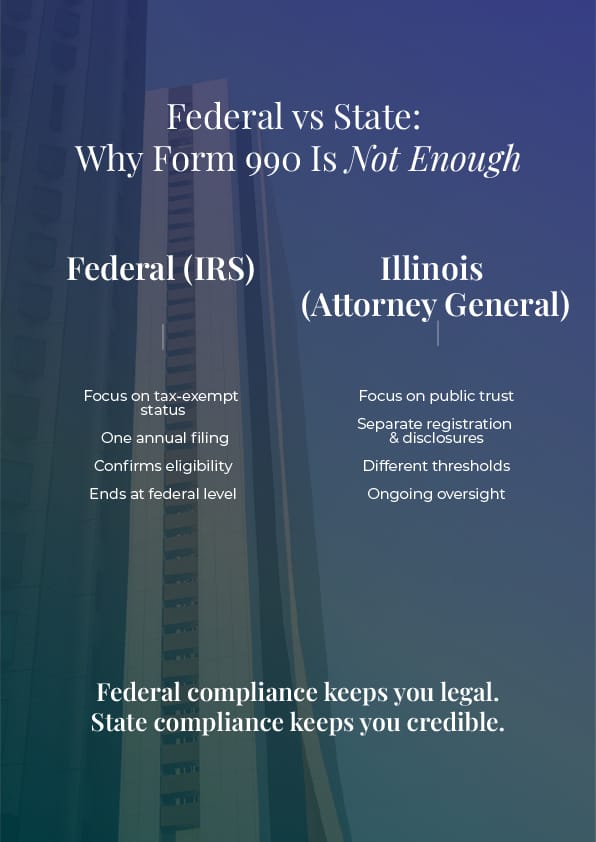
Filing Form 990 with the IRS does not automatically satisfy Illinois requirements.

Federal and state compliance serve different purposes:

Federal (IRS)Illinois (Attorney General)
Maintains tax-exempt statusOversees charitable activity
Requires annual Form 990 filingRequires charitable registration & reporting
Focuses on tax complianceFocuses on transparency and public trust
Federal deadlinesSeparate state deadlines

Federal compliance keeps your status intact.
State compliance protects public trust.
Illinois Audit vs. Review Requirements

Illinois adjusts financial reporting requirements as nonprofits grow. Revenue thresholds determine whether a nonprofit must submit:

Organization SizeRequired Financial Reporting
Smaller nonprofitsNo audit or review required
Mid-sized nonprofitsIndependent financial review
Larger nonprofitsFull independent audit

Crossing a revenue threshold can trigger higher reporting standards—often without obvious notice.

Growth is positive, but it changes expectations.

Audit vs. Review: What’s the Difference?

An audit and a review are not interchangeable.

AuditReview
Extensive testing and verificationLimited analytical procedures
Formal opinion issuedLimited assurance provided
Higher level of scrutinyFocuses on reasonableness
Required for larger nonprofitsRequired for mid-sized nonprofits

Submitting the wrong level of financial report can delay filings and create unnecessary follow-up with the Illinois Attorney General’s office.
Where Illinois Nonprofits Commonly Run Into Trouble

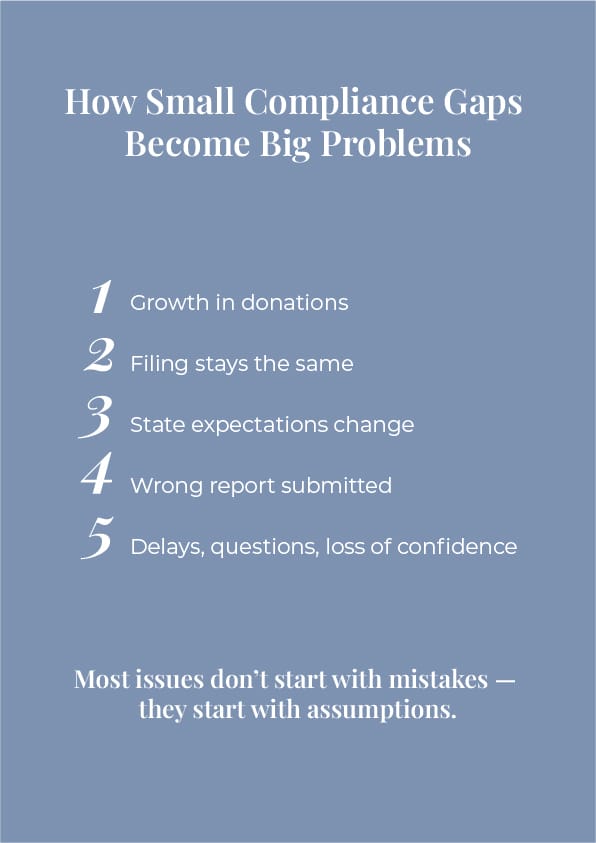
Most compliance issues do not start with wrongdoing. They begin with assumptions.

Common challenges include:

  • Filing Form 990 but overlooking Illinois charitable registration
  • Continuing last year’s reporting structure despite revenue growth
  • Missing state-specific deadlines
  • Assigning compliance to one person instead of board oversight
  • Waiting until questions arise before reviewing filings

Federal and state deadlines are separate—and not always aligned.

Staying Ahead of Compliance

When nonprofit growth aligns with updated compliance practices:

  • Filings reflect your current size and activity
  • Audit or review requirements are properly met
  • State registrations remain current
  • Board leadership stays informed

Compliance should evolve alongside growth—not trail behind it.

Work with SSL Associates

If you lead a nonprofit in Illinois and want clarity around Form 990 or state requirements, a proactive review can prevent costly delays and unnecessary stress.

SSL Associates helps nonprofits:

    • Prepare accurate Form 990 filings

    • Meet Illinois charitable registration requirements

    • Determine audit vs. review thresholds

    • Align reporting with growth

When compliance is aligned, your organization can focus fully on its mission.

Susan S. Lewis

Susan Lewis is a seasoned CPA and financial advisor with over 40 years of experience. She founded SSL Associates, offering personalized financial guidance and tailored solutions to help businesses achieve financial excellence.

Take the First Step Towards Financial Success - Contact Us Today!

Let’s transform your finances together. Schedule a consultation to unlock your path to success with our certified public accountants.

Similar Posts

Learn about Yellow Book Audits, when they’re required, and who needs them. If you need a Yellow Book Audit, contact our CPAs to ensure compliance.

Form 990: More Than a Tax Filing Many boards treat Form 990 as a routine federal filing. In reality, it’s a public document that reflects...

Updated:
By:Susan S. Lewis

Learn about Yellow Book Audits, when they’re required, and who needs them. If you need a Yellow Book Audit, contact our CPAs to ensure compliance.

Why Revenue Recognition Feels Harder Than It Should Revenue feels simple—until timing and conditions enter the picture. Grants and donations rarely arrive without context. Some...

Updated:
By:Susan S. Lewis

Learn about Yellow Book Audits, when they’re required, and who needs them. If you need a Yellow Book Audit, contact our CPAs to ensure compliance.

Why Weak Internal Controls Develop in Nonprofits Internal control gaps usually grow from practical decisions, not negligence. Common contributing factors include: In small organizations, combining...

Updated:
By:Susan S. Lewis

Learn about Yellow Book Audits, when they’re required, and who needs them. If you need a Yellow Book Audit, contact our CPAs to ensure compliance.

Why Outdated Systems Stick Around Most nonprofits do not intentionally choose outdated accounting systems. They keep them because they feel reliable. The staff know where...

Updated:
By:Susan S. Lewis

Learn about Yellow Book Audits, when they’re required, and who needs them. If you need a Yellow Book Audit, contact our CPAs to ensure compliance.

What Is Form 1099-NEC Used For? Form 1099-NEC is used to report nonemployee compensation. The IRS reinstated this form in 2020 to separate contractor payments from...

Updated:
By:Susan S. Lewis

Learn about Yellow Book Audits, when they’re required, and who needs them. If you need a Yellow Book Audit, contact our CPAs to ensure compliance.

What Is an Income Statement? An income statement, also called a profit and loss (P&L) statement, summarizes your business’s financial performance over a set period—monthly,...

Updated:
By:Susan S. Lewis