Key Takeaways
- A family office coordinates the financial and administrative affairs of a high-net-worth family.
- Family office services may include accounting, bill payment, reporting, cash flow management, tax coordination, investment administration, and recordkeeping.
- A single family office serves one family, while a multi-family office provides shared services to several families.
- A virtual family office combines outsourced professionals and technology without requiring a complete internal team.
- There is no universal wealth threshold for needing a family office. Financial complexity and administrative demands are often more important than net worth alone.
- A family office accounting firm can provide essential financial infrastructure without requiring the family to hire an entire in-house accounting department.
What Is a Family Office?
A family office is a dedicated team or service structure that manages the financial, administrative, and sometimes personal affairs of a high-net-worth or ultra-high-net-worth family.
Some family offices are formal organizations with full-time employees. Others are created through a network of outside accounting, tax, legal, investment, and administrative professionals who work together on the family’s behalf.
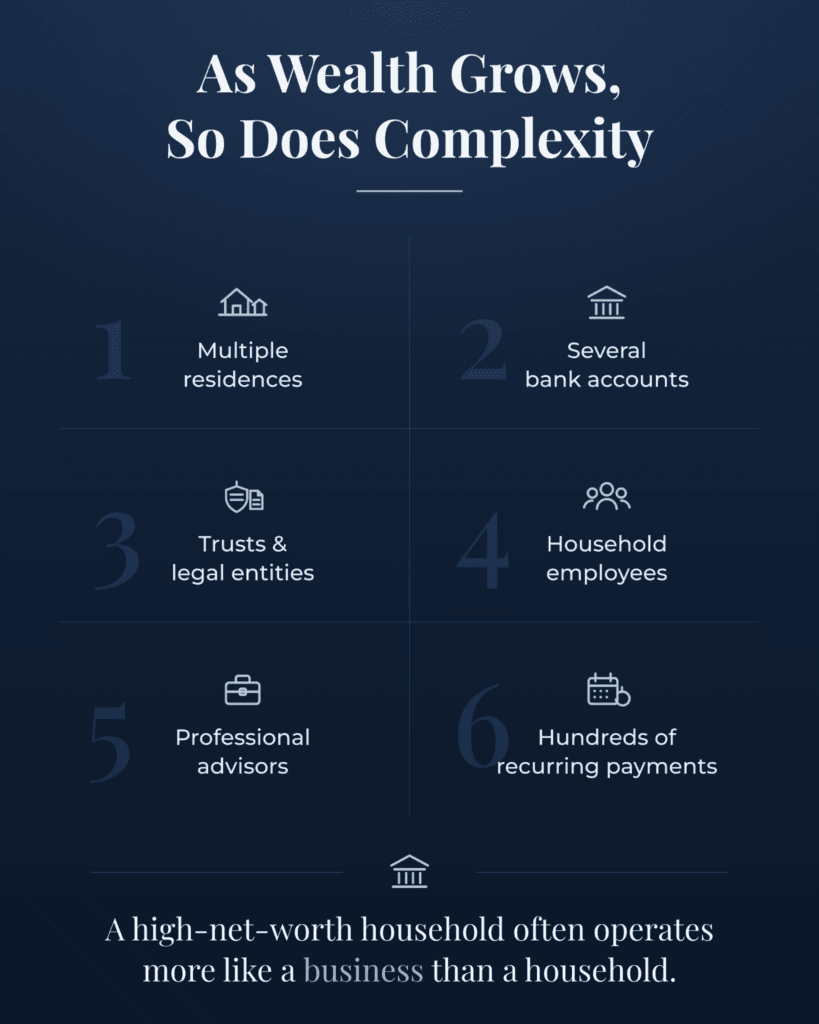
Although each family office is different, most are established to solve the same challenge: as wealth becomes more complex, managing it through separate advisors and disconnected systems becomes increasingly difficult.
A family may work with CPAs, investment advisors, attorneys, insurance professionals, trustees, business managers, and household employees. Each professional may understand one part of the family’s financial life, but no one may be responsible for maintaining a complete view.
A family office connects these responsibilities. It creates a central point of coordination and helps the family maintain organized records, accurate reporting, appropriate financial controls, and continuity over time.
What Does a Family Office Do?
Family office services are tailored to the family’s assets, priorities, and existing advisory relationships. A relatively simple arrangement may focus on bookkeeping, bill payment, and financial reporting. A more comprehensive family office may oversee nearly every aspect of the family’s financial and administrative life.
Common services include the following.
Family Office Accounting
Family office accounting provides the financial foundation for the broader family office structure. It involves recording, organizing, reconciling, and reporting activity across the family’s accounts, properties, businesses, trusts, foundations, and other entities.
Services may include:
- Bookkeeping and general ledger management
- Bank and credit card reconciliations
- Bill payment and expense tracking
- Multi-entity accounting
- Cash flow monitoring
- Budget preparation
- Financial statement preparation
- Consolidated financial reporting
- Document management and recordkeeping
- Coordination with tax and investment advisors
Accurate accounting helps family members understand where funds are held, how money is being used, which obligations are approaching, and how transactions relate to different entities.
Bill Payment and Household Administration
High-net-worth families may receive invoices related to multiple homes, household employees, insurance policies, contractors, professional services, education, healthcare, travel, taxes, and charitable commitments.
A family office can centralize these responsibilities by collecting invoices, reviewing charges, obtaining approvals, scheduling payments, recording transactions, and maintaining supporting documents.
This structured process reduces the risk of missed or duplicate payments while allowing the family to delegate routine administration without losing oversight.
Cash Flow Management
Significant wealth does not always mean that cash is readily available. A family’s assets may be concentrated in privately held businesses, real estate, investments, or other illiquid holdings.
A family office may monitor anticipated expenses, tax payments, capital calls, property costs, charitable commitments, and other obligations. This information can be coordinated with investment advisors or other responsible parties so sufficient liquidity is available when needed.
Financial Reporting
Family office financial reporting converts individual transactions into useful information.
Depending on the family’s needs, reports may show:
- Cash balances
- Income and expenses
- Costs by residence or property
- Spending by family member
- Activity by trust or legal entity
- Budget-to-actual results
- Upcoming financial obligations
- Charitable contributions
- Inter-entity transactions
- Changes in cash flow
Reports may be consolidated or prepared separately for individual entities. The goal is to provide a reliable financial overview without requiring family members to examine hundreds of transactions.
Tax and Advisor Coordination
A family office often works closely with tax professionals, attorneys, wealth managers, trustees, and other advisors. It helps ensure that these professionals receive complete and timely financial information.
A family office CPA or accounting team may maintain tax-ready records, track estimated tax payments, organize supporting documentation, prepare entity-level financial information, and respond to requests from outside tax professionals.
The family office does not replace every specialist. Instead, it creates the financial infrastructure that helps those specialists work efficiently.
Investment and Estate Administration
Investment decisions are typically made by the family and its registered investment professionals. However, the family office may support the administrative side of the process by organizing documents, tracking capital calls and distributions, maintaining entity records, and consolidating information from different custodians or investment managers.
A family office can also support estate planning administration by maintaining trust records, organizing legal documents, tracking ownership structures, and coordinating financial information requested by attorneys and trustees.
Philanthropic Administration
Families with significant charitable interests may use a family office to coordinate foundations, donor-advised funds, grants, and other philanthropic activities.
Services can include tracking charitable commitments, processing contributions, maintaining supporting records, managing foundation bookkeeping, and coordinating information with tax advisors.
Why Do Families Establish Family Offices?
A family office is often created when the family’s financial complexity begins to exceed its existing administrative structure.
A collection of independent advisors may work well while the number of accounts, entities, and transactions remains manageable. As the family’s financial life expands, however, several challenges may emerge:
- Financial information is distributed across different systems.
- No one maintains a complete view of the family’s finances.
- Bills and records are managed inconsistently.
- Family members spend too much time on administrative tasks.
- Accounts are not reconciled regularly.
- Advisors repeatedly request documents that are difficult to locate.
- Financial knowledge depends heavily on one person.
- Different entities use inconsistent accounting procedures.
- The family lacks consolidated financial reporting.
- There is no continuity plan for financial administration.
A family office addresses these problems by establishing clear responsibilities, organized workflows, consistent accounting, and coordinated reporting.
Types of Family Offices
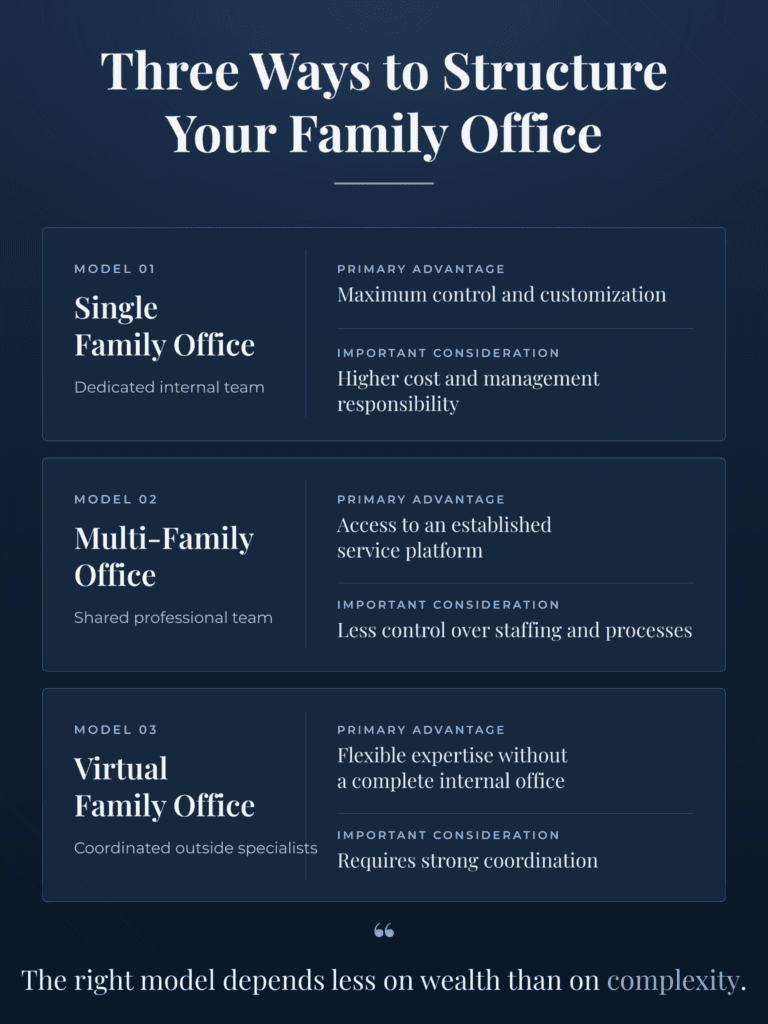
The most appropriate structure depends on the family’s complexity, desired level of control, service requirements, and available resources. The three common models are the single family office, multi-family office, and virtual family office.
Single Family Office
A single family office is established exclusively for one family.
It may employ accountants, investment professionals, administrative staff, tax specialists, and other personnel dedicated to that family. Outside professionals can be engaged when additional expertise is required.
The primary advantage is control. The family can select its employees, systems, procedures, and reporting standards. Team members also develop a detailed understanding of the family’s assets, preferences, and long-term priorities.
A single family office may be appropriate for families with highly complex assets, operating businesses, numerous trusts, substantial private investment activity, or several generations requiring ongoing support.
However, establishing one requires significant resources. The family must recruit, compensate, supervise, and retain qualified professionals while maintaining technology, security, processes, and internal controls.
Multi-Family Office
A multi-family office serves several unrelated families through a shared team and operating platform.
Families gain access to accounting, reporting, investment support, tax coordination, and other services without assuming the full cost of maintaining a dedicated office.
This structure may provide access to an established team, standardized technology, existing administrative processes, and multiple areas of expertise.
Because resources are shared, a multi-family office may be more cost-effective than a single family office. However, the family generally has less control over staffing, systems, and service delivery.
Families considering this model should understand which services are provided internally, which are outsourced, and how the provider approaches privacy, communication, and potential conflicts.
Virtual Family Office
A virtual family office delivers coordinated services through outsourced professionals and technology instead of a large internal team.
The family may retain its existing attorney and investment advisor while engaging a family office accounting firm to provide bookkeeping, bill payment, financial reporting, and administrative coordination.
This model may be appropriate for families that need greater organization but do not require a full internal office. It offers flexibility, access to specialized expertise, and the ability to expand services as the family’s needs evolve.
Its success depends on clearly defined responsibilities. The family should understand who maintains the accounting records, approves transactions, coordinates the advisors, and oversees the overall process.
When Does a Family Need a Family Office?
There is no universal net worth threshold for establishing a family office.
Two families with similar net worth may have very different needs. One may hold most of its wealth in a straightforward investment portfolio. Another may own several businesses, properties, trusts, foundations, and private investments. The second family may require considerably more coordination.
A family may benefit from family office services when:
- Financial administration consumes substantial time.
- The family manages multiple properties, businesses, trusts, or investment entities.
- Expenses are paid from several accounts.
- Bookkeeping and reconciliations are inconsistent.
- Financial information is held in disconnected systems.
- Several generations participate in financial decisions.
- The family lacks consolidated reporting.
- Advisors struggle to obtain current information.
- One individual holds most of the family’s financial knowledge.
- Privacy, oversight, or continuity has become a greater concern.
The need often becomes clear when the family cannot answer fundamental financial questions quickly. For example, what does each property cost to operate? How much cash is available? Which significant payments are approaching? Are all accounts reconciled? Which entity is responsible for a particular expense?
If answering those questions requires searching through emails, spreadsheets, and records held by several people, the family may have outgrown its current system.
The Role of a Family Office CPA
A family office CPA provides accounting knowledge within the broader family office structure. The CPA may work inside a single family office, as part of a multi-family office, or through an outsourced relationship.
The role often extends beyond annual tax preparation. A family office CPA may:
- Maintain general ledgers
- Reconcile financial accounts
- Prepare financial statements
- Manage multi-entity accounting
- Monitor cash flow
- Support budgeting
- Establish accounting procedures
- Organize financial documents
- Coordinate with tax advisors
- Assist trustees and attorneys
- Help establish appropriate financial controls
Because the CPA sees activity across multiple accounts and entities, they can help identify inconsistent practices, missing information, unusual transactions, and administrative gaps.
How a Family Office Accounting Firm Can Help
A family office accounting firm can serve as the financial operations center for families that do not want to build an entire accounting department internally.
The firm may provide bill payment, bookkeeping, monthly reconciliations, financial statements, multi-entity accounting, cash flow reporting, document management, and advisor coordination.
This outsourced approach gives the family access to experienced professionals and established processes while reducing the need to recruit and supervise multiple employees. It can also provide greater continuity by preventing important financial knowledge from being held by only one individual.
Outsourcing does not require the family to give up control. Payment approvals, access permissions, reporting expectations, and communication procedures should be clearly defined from the beginning.
What to Look for in a Family Office Provider
Because a family office provider may handle sensitive information and long-term responsibilities, families should consider:
- Experience with multi-entity accounting and financial reporting
- Services customized to the family’s actual needs
- Clearly documented roles and approval procedures
- Appropriate separation of financial responsibilities
- Strong confidentiality and information-handling practices
- Timely, accurate, and understandable reporting
- Effective communication with outside advisors
- The ability to expand services as the family’s needs change
The right provider should make the family’s financial life more organized and understandable while preserving the desired level of privacy and control.
Creating Clarity Across the Family’s Financial Life
A family office brings structure to the complex responsibilities that accompany significant wealth. It connects everyday financial administration with accounting, reporting, tax coordination, investment activity, estate planning, and long-term family priorities.
Whether a family chooses a single family office, multi-family office, or virtual family office, the central purpose is the same: to organize information, coordinate responsibilities, and provide a clearer understanding of the family’s financial affairs.