Key Takeaways
- Family office bill pay services manage more than payments. They may include invoice review, bookkeeping, reconciliations, document management, and financial reporting.
- Centralizing financial administration can help families manage multiple properties, accounts, entities, and vendors more effectively.
- Defined approval procedures and organized records create greater transparency and reduce the risk of missed, duplicate, or unauthorized payments.
- Consistent bookkeeping gives family members and their advisors a clearer understanding of household spending and cash flow.
- Outsourced family office accounting can provide the benefits of a dedicated financial team without requiring the family to build the entire function internally.
What Are Family Office Bill Pay Services?
Family office bill pay services provide structured support for the recurring financial obligations of high-net-worth individuals and families.
At the most basic level, the service ensures that invoices and household expenses are reviewed, approved, paid, and properly recorded. However, comprehensive support typically extends well beyond the payment itself.
Depending on the family’s needs, services may include:
- Receiving and organizing invoices
- Reviewing charges and payment details
- Routing invoices for approval
- Scheduling and processing payments
- Recording transactions in the appropriate accounts
- Reconciling bank and credit card accounts
- Maintaining invoices, receipts, and supporting documents
- Tracking recurring and upcoming obligations
- Preparing financial reports
- Communicating with vendors, household managers, CPAs, and wealth advisors
The objective is not simply to pay bills on time. It is to create a reliable financial administration system in which every transaction can be reviewed, documented, and understood.
Why Bill Pay Becomes More Complex as Wealth Grows
A household with significant wealth often operates more like a business than a traditional household. There may be multiple bank accounts, investment accounts, properties, employees, trusts, foundations, and privately held companies, each with its own expenses and reporting requirements.
A single family may need to manage:
- Utilities and maintenance for several residences
- Property taxes and insurance premiums
- Household employee wages and related expenses
- Payments to contractors and professional service providers
- Credit cards used by different family members
- Travel, education, and medical expenses
- Charitable contributions
- Trust- or entity-specific transactions
- Estimated tax payments
- Investment-related administrative expenses
These obligations may involve different approval authorities, payment schedules, and accounting classifications. When the process depends on spreadsheets, paper invoices, or information held by one family member or employee, it becomes easier for important details to be overlooked.
Household bill pay services for high-net-worth families provide a central process for managing this activity. The family gains an organized view of its financial obligations without needing to oversee every administrative step personally.
Bill Pay and Bookkeeping for High-Net-Worth Families
Bill payment and bookkeeping are closely connected. A payment may settle an invoice, but bookkeeping determines how that transaction is recorded, categorized, reconciled, and presented in future reports.
For example, a payment related to a residence may need to be assigned to a particular property, family member, trust, or legal entity. It may also need to be categorized as maintenance, insurance, utilities, professional fees, or a capital improvement.
Without accurate bookkeeping, a family may know that money left an account but not have a clear picture of where it went or how the expense relates to its broader financial position.
High-net-worth family bookkeeping helps create that clarity by ensuring transactions are:
- Assigned to the correct account or entity
- Categorized consistently
- Supported by appropriate documentation
- Reconciled against bank and credit card activity
- Included accurately in financial reports
- Available to tax and wealth advisors when needed
This creates continuity between everyday financial administration and the family’s larger accounting, tax, and wealth management needs.
How the Family Office Bill Pay Process Works
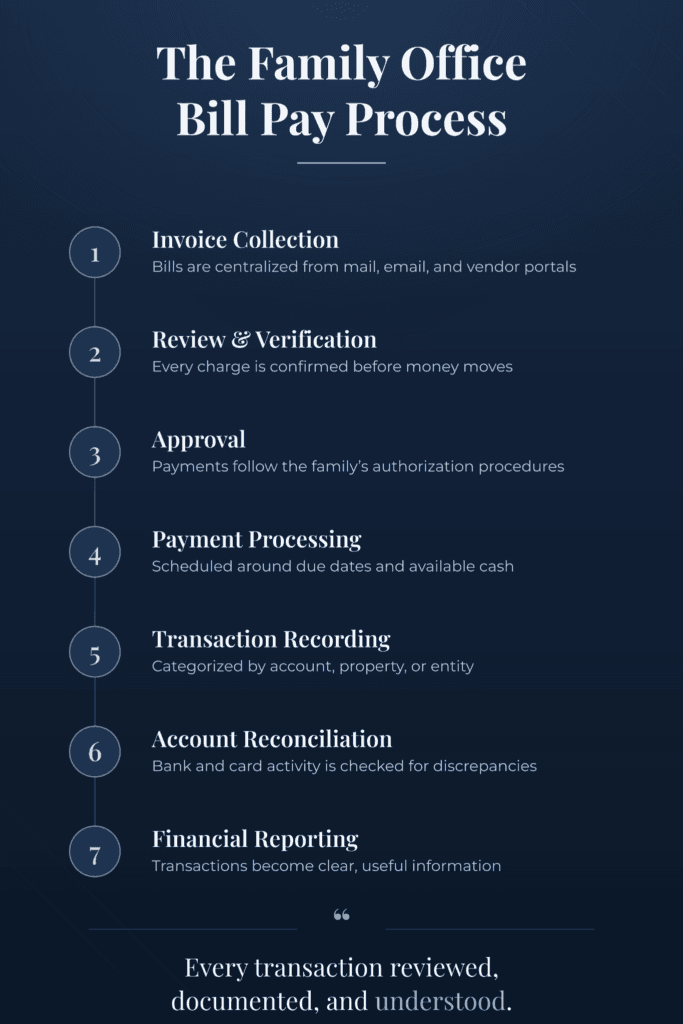
The exact process should be tailored to the family’s financial structure, preferences, and existing advisory relationships. In most cases, it includes the following steps.
1. Invoice Collection
Invoices may arrive through mail, email, vendor portals, household managers, or family members. Centralizing them reduces the likelihood that bills will be misplaced, overlooked, or paid twice.
2. Review and Verification
Before payment, each invoice is reviewed for accuracy. This may involve confirming the vendor, amount, due date, services provided, prior payment history, and the account or entity responsible for the expense.
Questions or unusual charges can then be investigated before money leaves the account.
3. Approval
Payments are routed according to the family’s established approval procedures. Routine expenses may follow one process, while higher-value or nonrecurring payments may require additional authorization.
This allows the family to delegate administrative work while retaining the desired level of control.
4. Payment Processing
Once approved, payments are scheduled using the appropriate account and payment method. Due dates and available cash are considered to help avoid late fees, service interruptions, and unnecessary transfers.
5. Transaction Recording
Each payment is recorded in the family’s accounting system and categorized appropriately. Supporting documents are linked or stored so the transaction can be reviewed later.
6. Account Reconciliation
Bank and credit card accounts are reconciled regularly. Reconciliation helps identify missing transactions, duplicate charges, incorrect amounts, or other discrepancies requiring attention.
7. Financial Reporting
Family office financial reporting converts transaction-level data into useful information. Depending on the family’s needs, reports may summarize cash balances, spending by property or entity, budget performance, outstanding obligations, and changes in cash flow.
The Benefits of Family Office Bill Pay Services
Greater Organization
A central bill pay process replaces fragmented information with a consistent system. Invoices, approvals, payments, and records are organized in one workflow, making financial information easier to find and review.
Fewer Missed or Duplicate Payments
When multiple individuals are involved in household finances, it may not always be clear whether an invoice has been received, approved, or paid. A structured process establishes responsibility at every stage and reduces the chance of bills falling through the cracks.
Better Financial Visibility
Accurate family office bookkeeping helps families understand how their money is being used. Rather than reviewing isolated transactions, they can see patterns in household expenses, property costs, professional fees, and other areas of spending.
Stronger Financial Controls
Defined approval procedures, transaction reviews, account reconciliations, and supporting documentation can reduce opportunities for error or misuse. These controls are particularly important when several family members, employees, vendors, or advisors have access to financial information.
More Efficient Advisor Coordination
Families often work with CPAs, tax professionals, wealth managers, attorneys, insurance advisors, and household managers. Organized records and timely reports help these professionals work from consistent financial information.
This can reduce time spent gathering documents, answering routine questions, or correcting incomplete records.
More Time for Family Priorities
Even when a family has the capacity to manage its bills internally, doing so may not be the best use of its time. Outsourcing routine financial administration allows family members to remain informed and in control without personally managing every invoice and payment.
Bill Pay Is Only One Part of Family Office Accounting
Bill pay is often the starting point, but families usually benefit most when it is integrated with broader family office accounting services.
These services may include:
- Monthly bookkeeping and account reconciliation
- Financial statement preparation
- Budget development
- Cash flow management
- Estimated tax payment tracking
- Coordination with tax advisors
- Document management and recordkeeping
- Fraud monitoring and transaction review
- Communication with vendors and other stakeholders
When these services work together, the family gains an organized financial foundation that supports planning, reporting, and informed decision-making.
For example, consistent transaction data can help answer questions such as:
- How much does each residence cost to operate?
- How is household spending changing over time?
- Are expenses aligned with the family’s budget?
- Which significant payments are approaching?
- Does a particular account need additional liquidity?
- Are advisors receiving the information they need?
Reliable answers depend on accurate, up-to-date records.
Outsourced Family Office Accounting vs. an Internal Team
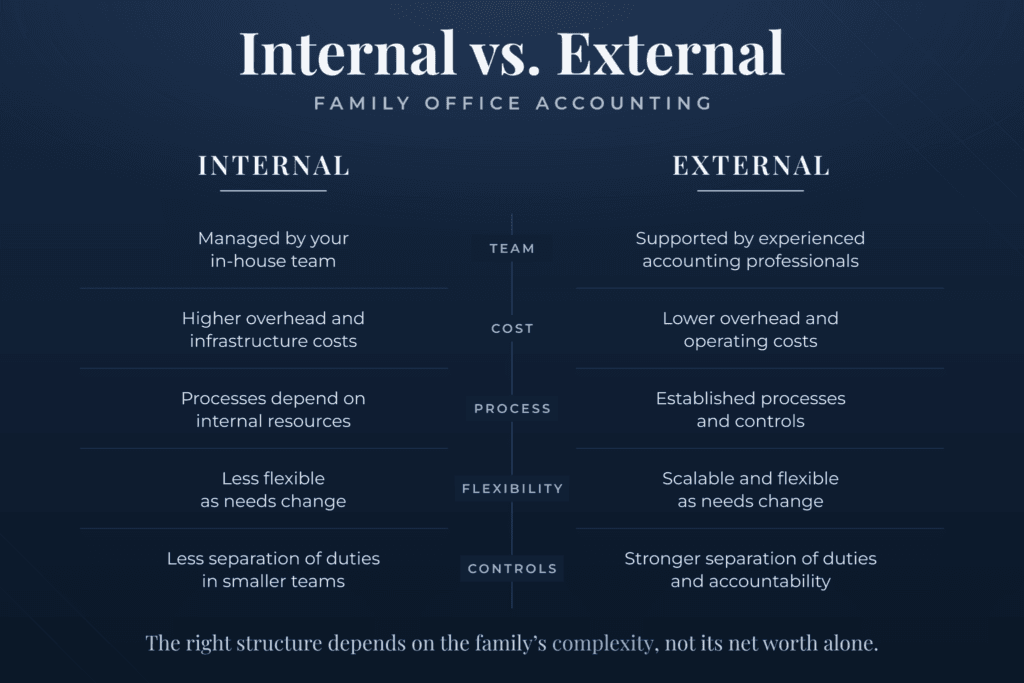
Some families establish a dedicated single-family office with employees responsible for bookkeeping, reporting, bill payment, and financial coordination. For others, maintaining a complete internal accounting function may add unnecessary cost and complexity.
Outsourced family office accounting provides an alternative. The family receives professional accounting support without needing to recruit, train, and manage every position internally.
An outsourced model may be appropriate when a family:
- Needs ongoing bill pay and bookkeeping support
- Has outgrown informal or spreadsheet-based processes
- Manages multiple residences or legal entities
- Wants clearer and more consistent reporting
- Needs additional support for an existing family office
- Wants stronger separation between payment, approval, and reconciliation duties
- Requires better coordination among household staff and outside advisors
Outsourcing does not mean giving up control. A well-designed engagement establishes which responsibilities are delegated, who can approve payments, what information is reported, and how frequently the family receives updates.
What to Look for in a Family Office Bill Pay Provider
Because the provider may handle sensitive financial information, the relationship should be evaluated carefully. Families and their advisors should consider the following areas.
Relevant Accounting Experience
The provider should understand bookkeeping, reconciliations, financial reporting, and multi-entity accounting; not only payment processing.
A Customized Process
Every family has a different combination of accounts, properties, entities, advisors, and preferences. The bill pay process should reflect that structure rather than relying on a one-size-fits-all workflow.
Clear Approval Procedures
The family should understand who can submit, review, approve, and process payments. Approval limits and exceptions should be documented.
Confidentiality and Discretion
Family financial information requires careful handling. The provider should demonstrate a professional approach to confidentiality, document management, and client communication.
Consistent Reporting
Reports should be accurate, timely, and understandable. The family and its advisors should be able to see where funds are being used and obtain supporting information when questions arise.
Direct Communication
High-net-worth households often require timely responses and personal attention. Families should know who is managing their accounts and how to reach that person when an issue requires action.
When Should a Family Consider Professional Bill Pay Support?
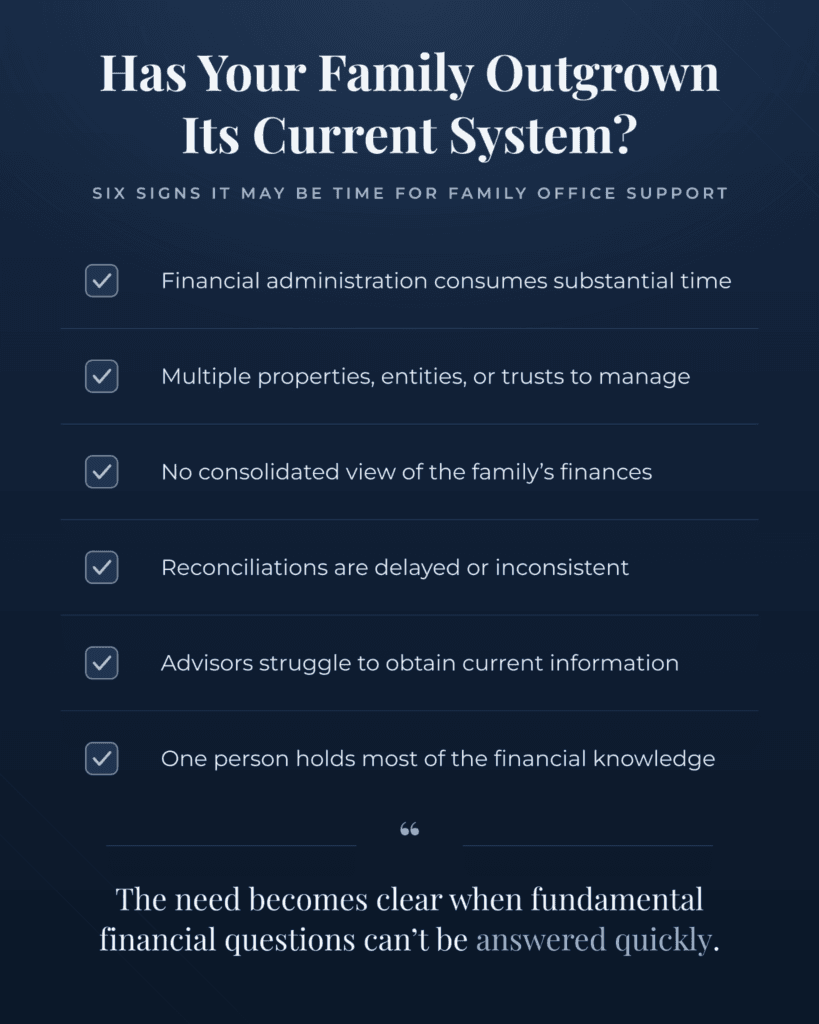
There is no single level of wealth or transaction volume that determines when a family should seek assistance. The need usually becomes apparent when financial administration begins consuming too much time or becomes difficult to manage consistently.
Common signs include:
- Bills are being paid from multiple accounts without centralized tracking.
- One person holds most of the household’s financial knowledge.
- The family manages several residences, employees, or business interests.
- Advisors frequently request documents that are difficult to locate.
- Monthly spending is not clearly categorized or reported.
- Reconciliations are delayed or completed inconsistently.
- Family members want to delegate administrative work without losing oversight.
- Existing staff need additional accounting support.
Addressing these issues early can help the family develop better processes before its financial life becomes even more complex.
Creating Clarity in Everyday Financial Management
For high-net-worth households, bill payment is not an isolated administrative task. It is part of a larger system that connects household operations, accounting, tax planning, cash management, and financial reporting.
Family office bill pay services bring structure to that system. With invoices reviewed, payments authorized, accounts reconciled, and transactions accurately recorded, families gain greater confidence in their day-to-day financial affairs.
The result is not only greater convenience. It is clearer reporting, stronger coordination, and a more dependable financial foundation.