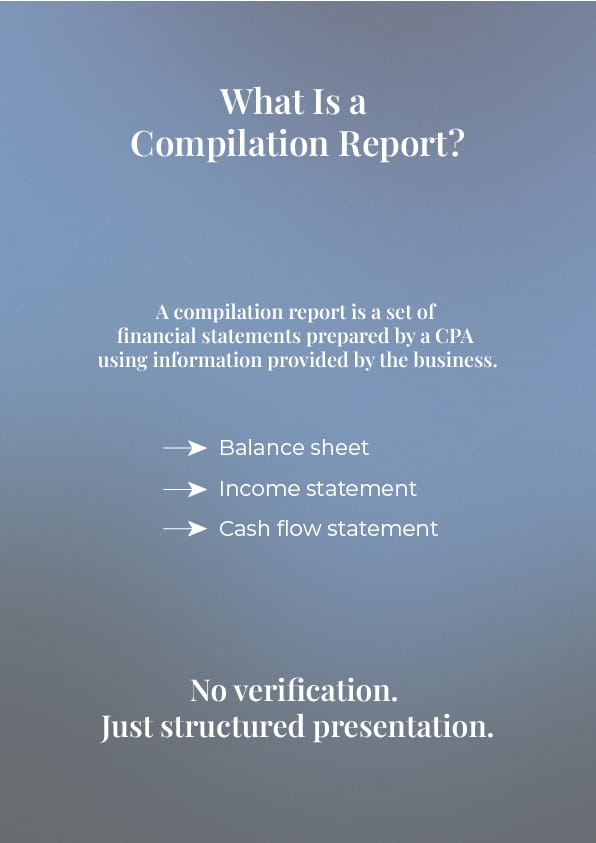
A compilation report is a set of financial statements prepared by a CPA using information provided by you or your organization. Unlike an audit or review, a compilation does not include verification procedures or an in-depth examination of the numbers. Instead, the CPA organizes your financial data into standard and readable financial statement formats, including a balance sheet, income statement, or cash flow statement.
Organizations commonly request compilation reports for presentation to lenders or investors, for internal planning, or simply to gain year-end financial clarity. Understanding how compilation reports work, and when you should request a compilation engagement from a CPA, can help you determine whether one is right for your needs.
What is a Financial Review?
To better understand a compilation report, it helps to compare it with a review. A financial review is a financial statement analysis performed by a CPA that provides limited assurance to lenders, investors, and other stakeholders. During a financial review, the CPA performs analytical procedures, compares financial trends over time, and makes inquiries of management to determine whether any modifications need to be made so that the statements conform with reporting standards.
What is a Compilation Engagement?
A compilation engagement is the process by which a CPA prepares a compilation report. The compilation report is an accurately formatted and organized presentation of your financial statements, prepared by a CPA using financial data you provide. The CPA’s role is to assemble the information into a standard financial statement format and ensure it is presented clearly and consistently.
In a compilation engagement, the CPA does not test transactions, confirm balances, or verify the accuracy of the information. Instead, they rely on the data provided by the client.
Because the resulting compilation report follows standardized reporting formats, it is easier for banks, investors, and other third parties to understand. Internally, they also provide leadership teams with a clearer financial snapshot, helping guide budgeting, forecasting, and strategic decisions.
Audit vs. Review vs. Compilation
When deciding which level of service your organization needs, it’s helpful to understand the differences between an audit, a review, and a compilation.
An audit provides the highest level of assurance. During an audit, a CPA conducts a thorough examination of financial records, tests selected transactions, evaluates internal controls, and verifies supporting documentation. The goal is to determine whether the financial statements are free from error or fraud. Because of the depth of work involved, audits are typically required by larger organizations, regulatory bodies, or lenders with stricter requirements.
A review provides limited assurance. Instead of extensive transaction testing, the CPA performs analytical procedures and asks management questions to identify unusual trends or inconsistencies. A review offers more confidence than a compilation but does not reach the level of scrutiny found in an audit.
A compilation does not provide assurance, but rather gives the client an organized collection of their financial documents. When undertaking a compilation engagement, the CPA organizes and presents financial data supplied by management in the proper format but does not verify the accuracy of the information. Compilations are often the most cost-effective and efficient option when assurance is not required.
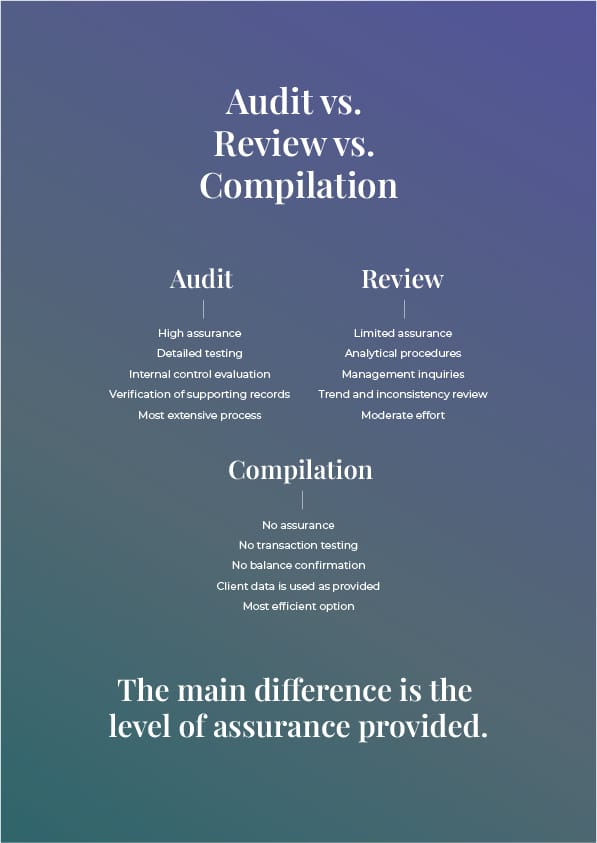
Ultimately, the main difference between an audit, a review, and a compilation lies in the level of assurance provided. The higher the level of assurance, the more detailed and time-intensive the process.
Why Do I Need a Compilation Report?
A compilation report is often requested when an organization needs professionally prepared financial statements but does not require the higher level of assurance that comes with a review or audit.
Common reasons to request a compilation include:
- Applying for a business loan where audited statements are not required
- Presenting financial information to potential investors
- Supporting tax preparation and filing
- Fulfilling partnership or shareholder agreements
- Improving internal financial oversight and planning
For small to mid-sized businesses, a compilation can serve as an important financial management tool. By converting raw bookkeeping data into structured financial statements, it becomes easier to evaluate profitability, monitor expenses, and assess overall financial health.
Compilations are generally less time-consuming and more affordable than reviews or audits because they do not involve in-depth testing or verification procedures. For many organizations, this makes them a practical choice when the goal is clarity and organization rather than formal assurance.
When Should You Request a Compilation Engagement by a CPA?
You may want to request a compilation engagement from a CPA if:
- Your lender or investor requires professionally prepared financial statements but not audited ones
- You are preparing for year-end reporting
- You want a clear, standardized presentation of your financial position
- You are seeking better internal decision-making tools
- You are a growing business transitioning from informal bookkeeping to more structured reporting
As your organization grows, your financial reporting needs will evolve. A compilation can be a stepping stone toward more comprehensive reporting in the future, while still providing immediate clarity and professionalism.
Final Thoughts
Understanding your or your organization’s financial health begins with having well-organized and professionally prepared financial statements. A compilation report provides structure, clarity, and credibility without the time and cost commitment of an audit or review.
At SSL Associates, we specialize in helping our clients feel confident in their financial standing. Our experienced CPAs prepare efficient, accurate, and streamlined compilation reports that transform complex financial data into organized, easy-to-read statements. With a professionally prepared compilation report, you can move forward knowing your financial information is clearly presented and ready to support informed decision-making.