Why Revenue Recognition Feels Harder Than It Should
Revenue feels simple—until timing and conditions enter the picture.
Grants and donations rarely arrive without context. Some support future programs. Some depend on milestones. Some restrict how or when funds can be used.
The key question becomes:
Is this revenue now, or later?
As organizations grow, these distinctions matter more. That’s where ASC 958 comes in.
Contributions vs. Exchange Transactions (ASC 958 Overview)
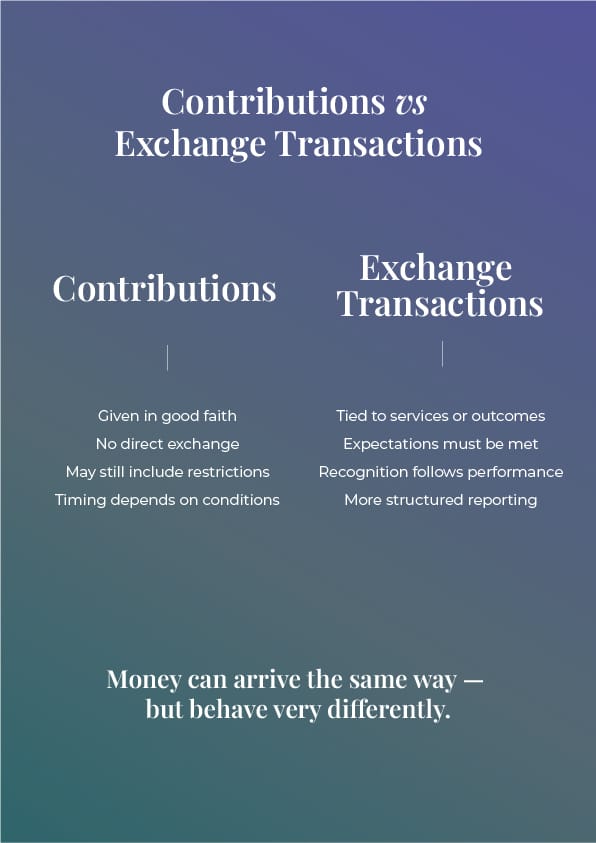
Under ASC 958, nonprofits must determine whether funding is a contribution or an exchange transaction.
Key Differences
| Contributions | Exchange Transactions |
| Given without equal value returned | Involves reciprocal exchange |
| Donor supports mission broadly | Funder receives direct benefit |
| May include restrictions | Tied to performance obligations |
| Governed by ASC 958 | Often governed by ASC 606 |
| Recognized based on conditions | Recognized as services are delivered |
Why it matters:
Misclassifying a grant or contract can change how and when revenue appears in your financial statements.
Conditional vs. Unconditional Contributions
Once funding is classified as a contribution, the next step is determining whether it is conditional or unconditional.
Conditional Contribution
| Feature | Treatment |
| Includes measurable barrier or milestone | Not recognized as revenue until met |
| Funder can require repayment | Recorded as liability until satisfied |
| Depends on future action | Revenue recognized when condition is substantially met |
Unconditional Contribution
| Feature | Treatment |
| No measurable barrier | Recognized when received or pledged |
| No right of return once awarded | Recorded as revenue immediately |
| May still include donor restriction | Reported in net assets with donor restrictions |
The presence of a barrier and right of return is what typically makes funding conditional under ASC 958.
Grants vs. Donations: Why Timing Differs
Grants and donations may feel similar, but they often behave differently in reporting.
| Grants | Donations |
| Frequently tied to specific programs | Often broader mission support |
| May include performance milestones | May include purpose restrictions |
| Government grants often conditional | Many donations are unconditional |
| Timing depends on milestones | Timing depends on restrictions |
Common Grant Conditions
- Measurable performance outcomes
- Reimbursement structures
- Phased funding releases
- Clawback or repayment clauses
If those conditions exist, revenue is typically recognized as conditions are satisfied—not when cash is received.
Donor Restrictions: Another Layer of Complexity
Even when a contribution is unconditional, it may still be restricted.
Without Donor Restrictions
- Revenue recognized immediately
- Reported in net assets without donor restrictions
With Donor Restrictions
- Revenue recognized immediately
- Reported in net assets with donor restrictions
- Reclassified when restriction is satisfied
The accounting recognition happens upfront. The presentation changes based on restrictions.
Where Revenue Recognition Commonly Goes Wrong
Most issues do not start with bad intent—they start with timing misunderstandings.
| Common Issue | Result |
| Treating conditional grant as immediate revenue | Overstated revenue |
| Ignoring donor restrictions | Misclassified net assets |
| Misclassifying exchange transaction as contribution | Incorrect accounting standard applied |
| Recognizing revenue based on deposit date | Financial statement confusion |
Boards often notice inconsistencies first:
- Why does this year’s revenue spike?
- Why does next year look weaker?
- Why are auditors asking follow-up questions?
Early classification prevents those surprises.
Why Early Clarity Matters
When revenue is recognized properly:
- Financial statements tell the right story
- Boards make informed decisions
- Audits move more smoothly
- Leadership communicates with confidence
Revenue clarity protects credibility and supports the mission.