Where is our money going?
A consolidated spending figure offers a quick sense of scale. It becomes less informative when a family needs to distinguish ordinary household expenses from a property renovation, an entity obligation, or a payment made on someone else’s behalf.
Detailed reporting can make those distinctions visible, but collecting and maintaining that detail requires effort. Categories that are useful to the CPA may be excessive for a family member reviewing the month. A practical reporting structure can accommodate different views while retaining a consistent record beneath them.
There is also a distinction between combining information and combining ownership. Accounts held by different people or entities may appear in an overall family view, while their legal and accounting identities remain separate. Transfers between accounts need context to avoid distorting the picture.
This is where the scope of a provider’s work becomes important. A report drawn from selected accounts can be accurate without representing the whole family. Its value depends partly on whether the reader understands what is included.
What changed this month?
A comparison with the previous month can reveal a change quickly. A comparison with the budget can reveal a different one. Neither explains, by itself, whether the difference reflects a concern, an expected event, or the timing of a payment.
An annual insurance premium may make one month look unusually expensive even when the household is following its plan. A series of smaller, recurring increases may be less conspicuous while having a greater effect on future spending.
A more detailed analysis can separate these patterns, although it depends on reliable categories, meaningful budgets, and access to the people who understand the transactions. Software can highlight a difference; explaining why it matters may require knowledge that sits with a household manager or another advisor.
The degree of explanation worth paying for depends on the decisions at stake. A family with stable expenses may need relatively little commentary. Renovations, new properties, or changing responsibilities can make the interpretation more valuable.
What payments are coming up?
A report of completed transactions provides a useful history. It may offer limited visibility into commitments that have been agreed but have not yet reached the accounts. Tuition, property work, and other significant obligations can create demands that a balance alone does not explain.
Including anticipated payments brings the report closer to the family’s immediate decisions. It also introduces uncertainty: an invoice may change, a project may be delayed, or an amount may still require approval. The usefulness of that information depends on how clearly its status is understood.
Different service arrangements handle this boundary differently. Someone engaged to record transactions may have little visibility into future commitments. A bill-payment engagement may cover known invoices, while broader cash planning requires additional information and coordination.
These distinctions matter when a family relies on assets or accounts managed elsewhere to fund expenses. A clear view of upcoming obligations gives the relevant advisors context for discussing timing and funding, within their respective responsibilities.
Do the numbers match?
Reports assembled from account feeds can be available quickly and reduce manual data entry. Reconciled records offer a different degree of confidence: differences between the accounting records and account statements have been examined and addressed or identified as outstanding.
Speed and completeness can pull in different directions. Waiting for every document may delay information the family needs. Issuing a report promptly may mean that some figures remain preliminary. Either approach can be reasonable when the limitations are visible.
A mismatch also requires interpretation. An outstanding payment, a duplicate entry, and an unfamiliar charge call for different responses. Reconciliation does not, by itself, establish that every transaction was authorized or that fraud is absent.
The value of professional involvement lies partly in understanding what has been checked and what requires further attention. A polished report can create confidence, but the work supporting it—and the scope of that work—determines how much reliance is appropriate.
Do our advisors have what they need?
A CPA, wealth advisor, attorney, and household manager may need different information from the same financial activity. Sharing everything with everyone can create unnecessary disclosure and distraction. Sharing too little can leave a professional making decisions without relevant context.
Centralized records can reduce repeated requests and make supporting documents easier to locate. That benefit depends on appropriate access, consistent definitions, and someone taking responsibility for unresolved questions. It does not require every professional to work in the same system.
An internal employee may understand the family’s preferences and history particularly well. An outside accounting provider may offer additional capacity and continuity. A combination can be effective, while introducing handoffs that need clear ownership. The label attached to the arrangement says less than the actual responsibilities and information flows.
A family may already have the right specialists. The gap may be coordination: connecting the information they hold so that each can carry out their own role effectively.
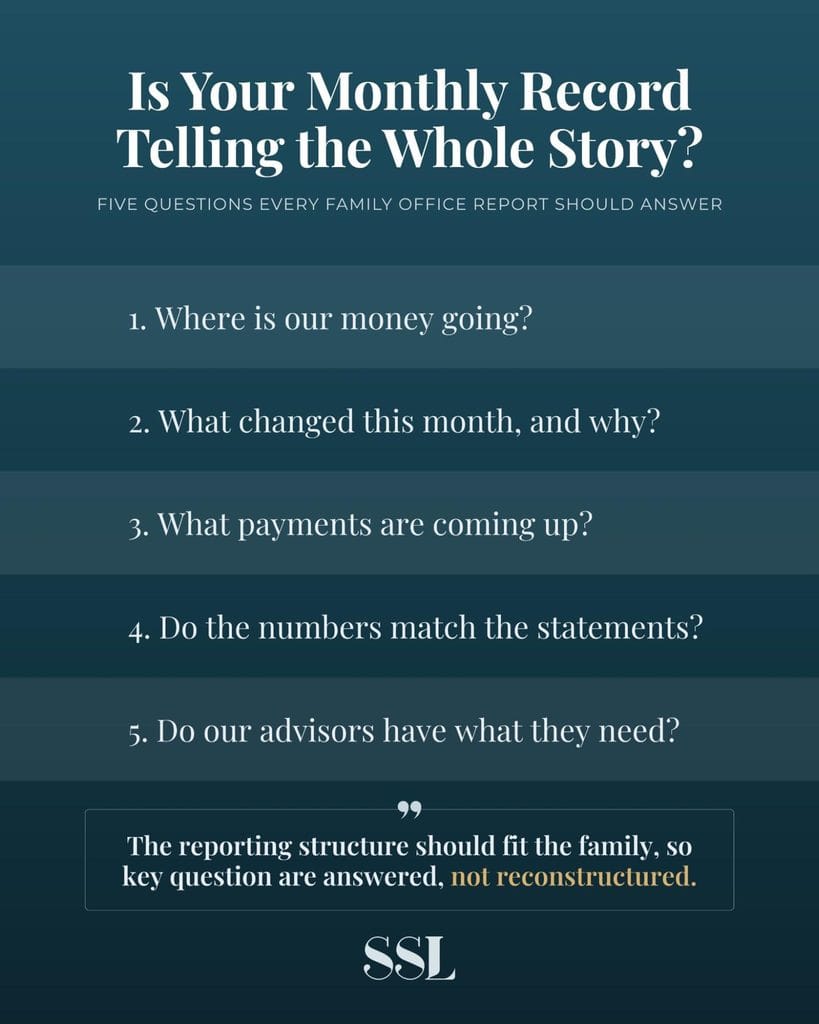
The reporting structure should fit the family
Useful monthly reporting reflects a series of choices about detail, timing, privacy, cost, and responsibility. A straightforward arrangement can serve a straightforward situation well. As properties, entities, and commitments accumulate, the same arrangement may place more demands on family members than they expected.
The point at which guidance becomes valuable is often recognizable: the family has plenty of information, but answering a consequential question still requires reconstructing events across several people and accounts.
SSL Associates supports family office operations through bookkeeping, financial statement preparation, reconciliation, budgeting, and coordination with professional advisors. That work can help families understand which reporting arrangement fits their needs and where additional specialist input would improve the decisions they make.
Sources and Further Reading
Sources supporting the discussion of association funding, charitable giving, and family office reporting.
Community Associations Institute. Navigating Insurance Pressures in Today’s Condo Market. Association insurance costs and coverage conditions.
Community Associations Institute / HOAresources. Reserve Studies: Roadmaps to Financial Health. Reserve planning and anticipated repair costs.
Popular Association Banking / HOAresources. Is Your Community Association in Need of Major Repairs? Financing through reserves, special assessments, and borrowing.
Illinois Department of Financial and Professional Regulation. Illinois Condominium Property Act. Section 9, including assessment-lien enforcement, in the edition effective January 1, 2025.
Allstate. What Is Condo Loss Assessment Coverage? Coverage for certain assessments associated with insured losses.
Internal Revenue Service. Publication 526: Charitable Contributions. Asset gifts and substantiation. The available 2025 edition supports these principles; 2026 deduction changes are addressed in Publication 505.
Internal Revenue Service. Publication 505 for 2026. Charitable deduction floor and other applicable deduction limitations.
Internal Revenue Service. Donor-Advised Funds. Sponsoring organizations’ legal control and donors’ advisory privileges.
Fidelity Charitable. Benefits of the Giving Account. Contributions, grants, program conditions, administrative fees, and investment expenses.
Internal Revenue Service. Private Foundation: Annual Return. Form 990-PF filing requirements.
SSL Associates. Family Office Accounting Services. Accounting support and coordination with families’ professional partners.