Direct giving offers simplicity, with limits
A cash gift made directly to a charity has an understandable appeal. The recipient is identified, the payment is easy to recognize, and the donor can maintain a personal relationship with the organization. For a family supporting a small number of charities, this may be an efficient arrangement.
As activity grows, the administration can become scattered. Recurring payments, event sponsorships, workplace donations, and gifts from different accounts may each produce their own records. The individual transactions remain simple, while the overall picture becomes harder to assemble.
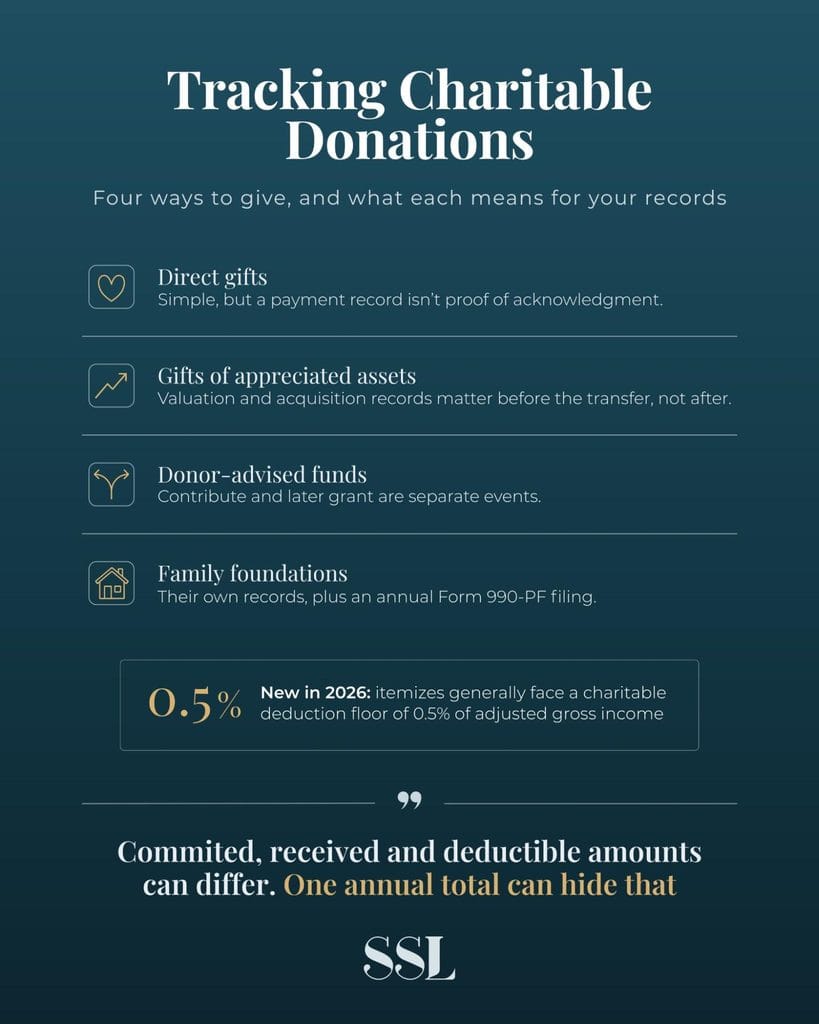
A payment record also answers a narrower question than many donors assume. It establishes that money moved, but may not resolve the recipient’s eligibility, the value of any benefit received, or whether the required acknowledgment exists. A fundraising event illustrates the distinction: the payment can support the organization while also purchasing something of value for the donor.
Giving assets changes the planning conversation
Gifts of appreciated securities or other property can be attractive when a family wants its giving to reflect the assets it already holds. Certain qualifying gifts may offer tax advantages compared with selling an asset and donating the proceeds. The outcome depends on the asset, the donor’s circumstances, the recipient, and applicable limits.
The additional considerations can be substantial. Publicly traded shares, a privately held business interest, and real estate are very different contributions. Valuation, transfer restrictions, the charity’s ability to accept the asset, and the timing of completion may all affect whether a proposed gift is workable.
These questions give recordkeeping a role before the gift is completed. Acquisition information and ownership details may influence the advice itself. Once a transfer has occurred, missing documentation can be difficult to reconstruct, and some decisions are no longer available. For complex assets, coordination among the donor’s tax, legal, and financial advisors becomes part of evaluating the gift.
A donor-advised fund separates contribution from distribution
A donor-advised fund can bring administration into one place and allow a family to contribute assets before deciding which charities will ultimately receive grants. That separation can be useful when the timing of a financial event differs from the family’s preferred giving schedule.
The arrangement also changes control. Contributions belong to the sponsoring charity, while donors retain advisory privileges. The money is committed to charitable use. Sponsor policies, administrative charges, investment expenses, and the investment options available can affect how the arrangement works in practice.
For reporting purposes, a contribution to the sponsor and a later grant are separate events. The grant history helps explain where charitable support went; it should not be added to the original contribution as another personal gift. A provider may make its own account history easy to access, while the family still needs a view of giving conducted elsewhere. Convenience within one platform is only part of the overall record.
A family foundation brings a different level of responsibility
A private foundation can provide a formal setting for a family’s charitable priorities and participation across generations. It may appeal to families that want ongoing involvement in grantmaking and are prepared to maintain an organization around that work.
That involvement carries administrative and regulatory responsibilities. Private foundations must file an annual Form 990-PF, and their activity belongs in the foundation’s own records. A family’s contribution to the foundation and the foundation’s subsequent grants have different reporting significance.
The comparison with direct giving or a donor-advised fund therefore extends beyond the size of the donation. It includes how much involvement the family wants, the resources available to support the structure, and whether those responsibilities fit its goals. A more elaborate arrangement can support a clear purpose, but complexity alone adds no philanthropic value.
Tax timing and charitable purpose do not always move together
A charity may need dependable support each year, while a donor’s income and available assets vary substantially. A structure that accommodates both can be helpful, although the best answer depends on the family’s circumstances.
Changes in tax rules can make the comparison more sensitive. Beginning in 2026, itemizers generally face a charitable deduction floor of 0.5% of adjusted gross income, alongside other applicable limits. This is one reason the same gift can have different tax consequences for different donors or in different years.
That does not make a tax benefit the sole measure of a successful gift. Committing resources earlier may support a planning objective while reducing personal flexibility. Waiting may preserve flexibility while changing the timing of support. Reliable records let advisors evaluate those consequences against the family’s intentions, rather than assuming that the largest donation total represents the best outcome.
The gaps often sit between providers
A charitable sponsor, investment advisor, CPA, and family office may each hold accurate information about the part they handle. Difficulty arises when the family expects those separate views to form a complete picture automatically.
One provider may know that securities were transferred, another may hold the acknowledgment, and a third may be tracking future commitments. Where several people or entities are involved, the value of guidance includes identifying which information belongs together and where a decision needs specialist input.
A dedicated giving platform may be sufficient for relatively contained activity. Broader accounting support becomes more relevant when donations cross accounts, entities, assets, or tax years. The appropriate level of support follows the complexity of the arrangements and the questions the family needs answered.
SSL Associates helps organize financial records and coordinate information with families’ professional advisors. That support allows charitable giving to be considered alongside the family’s other financial commitments, with a clearer understanding of what has been contributed, what remains planned, and where further advice is needed.